
Why Beef Is So Expensive (And Who Gets Your Dollar)
USDA has split every beef dollar three ways since 1970. Open the ledger, and the usual answer about who is getting rich turns out to be right one year and wrong the next.
 Film coming to YouTube
Chapters
- Who gets your beef dollar
- Fewer cows
- The ledger
- The four packers
- The slice that vanished
- After the plant
- When cattle got cheaper
- So who gets it
In August 2026, a pound of ground beef in America cost an average of $6.92. That is the highest price in the government's records, which go back to 1984. In 2019 the same pound averaged $3.81.C01
Ask who is to blame and most people give the same answer: four meatpacking companies. They do buy about 85 percent of the steers and heifers that become American beef.C09 But there is a better place to look than the companies' reputations. The U.S. Department of Agriculture keeps a ledger.
The ledger
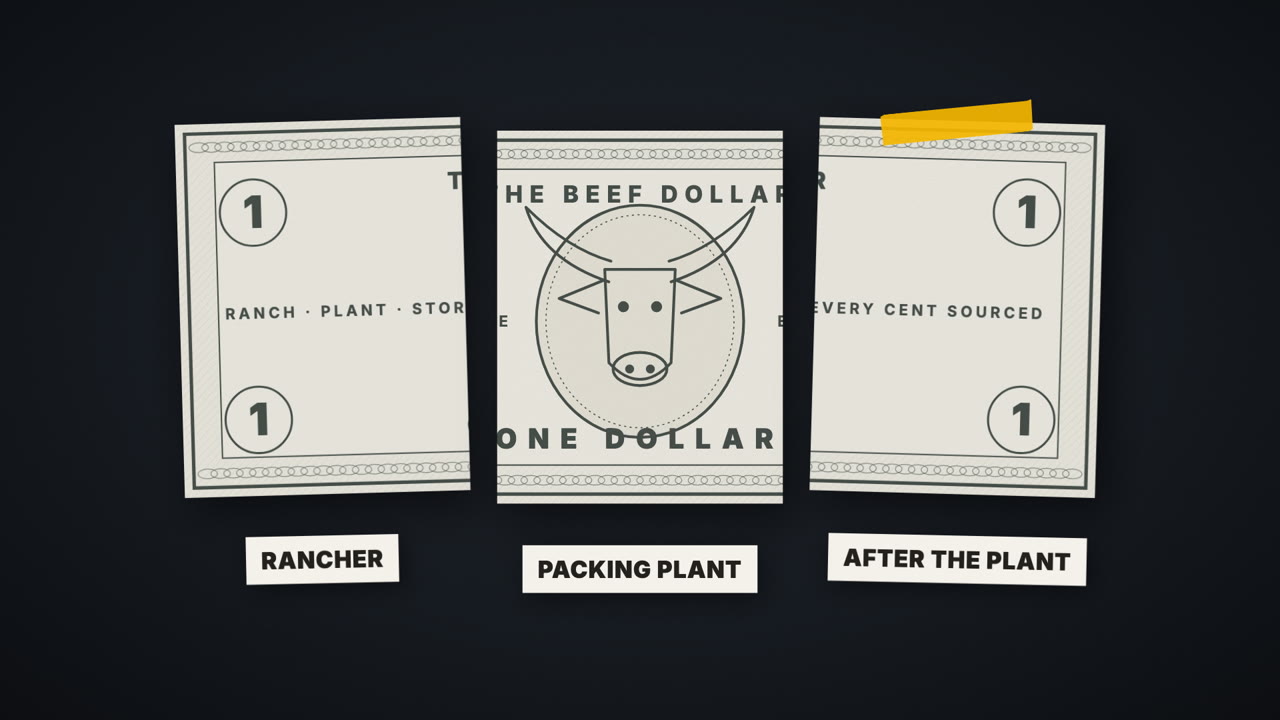
Every month since 1970, USDA's Economic Research Service has split the retail value of a pound of Choice beef into three slices:C15
- The rancher: what the animal is worth at the farm, minus the value of hides and other byproducts.
- The packing plant: the gap between the farm value and what the meat is worth as boxed beef leaving the plant.
- Everything after the plant: the gap between that wholesale value and what you pay at the counter. That slice pays for trucks, cold warehouses, the butcher who cuts a box of beef into steaks, the store's lights and labor, and its margin.
Two details matter before reading any number. ERS models a standard steer, cut a standard way, with fixed conversion factors (it takes 2.4 pounds of live steer to make a pound of retail beef). That makes years comparable, but it is not any one company's books. And each slice is a gross spread: it has to cover that stage's costs. A slice is not a profit.
Here is what the ledger shows, in cents of each retail dollar:
| Year | Rancher | Packing plant | After the plant |
|---|---|---|---|
| 1970 | 64.2 | 12.6 | 23.1 |
| 1980 | 62.3 | 10.9 | 26.8 |
| 1990 | 59.9 | 7.5 | 32.5 |
| 2000 | 48.6 | 10.9 | 40.5 |
| 2010 | 46.5 | 8.5 | 45.0 |
| 2021 | 36.8 | 21.6 | 41.6 |
| 2025 | 53.5 | 4.7 | 41.8 |
| 2026, Jan-Oct | 52.4 | 3.2 | 44.3 |
Source: USDA ERS Meat Price Spreads, annual averages of monthly values. 2026 is the January-October average. Download the full series below.C15C22C23
Who gets each dollar spent on Choice beef (cents)
The story everyone tells was true in 2021
Between 1980 and 2021, the rancher's slice fell from 62 cents to 37 cents. The packing plant's slice doubled, to 21.6 cents in 2021, the biggest it had been since the ledger began.C15C22
The companies' own filings fit that picture. In fiscal 2021, Tyson's beef business reported operating income of $3.24 billion, an 18 percent margin.C08 Concentration fits too: in 1980 the four largest packers bought 36 percent of steers and heifers; by 1995, 81 percent; today, about 85 percent.C09
If the film stopped in 2021, "ranchers get less and less of every dollar while the packers get more" would be an accurate summary.
Then the slice vanished
In 2025, the packing plant's share of the beef dollar was 4.7 cents, the smallest annual share in the 56 years of the ledger. In February and May 2026 it fell below one cent.C22
The filings show the same squeeze. Tyson's beef segment lost $426 million in fiscal 2025 on its adjusted measure, and $1.135 billion as reported.C21 In the first nine months of fiscal 2026 it lost another $483 million, adjusted.C06 In September 2026 the company guided to a full-year beef loss of $625 million to $775 million, citing "one of the most severe cattle shortages in U.S. history."C07
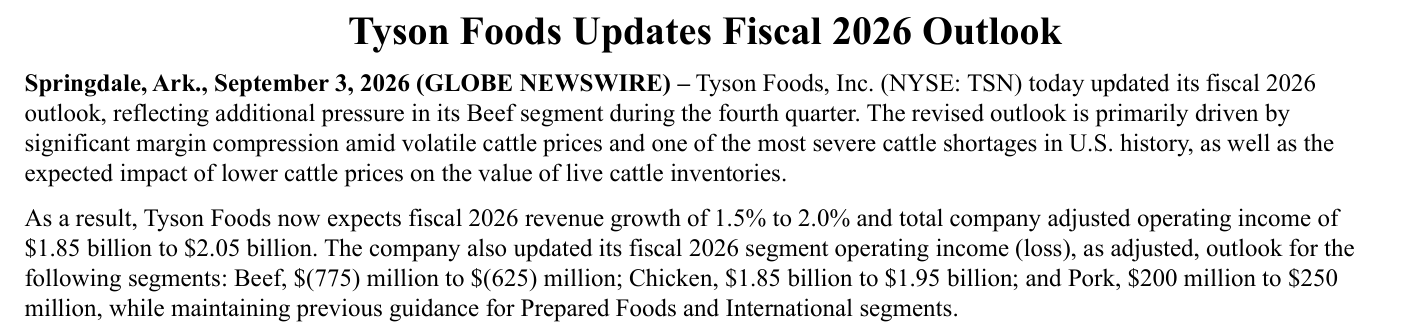
The ledger cannot show any one company's margins. But the direction is the same: the companies that buy most of the cattle were paying so much for them that the plant's slice nearly disappeared.
The money moved up the chain. In May 2026 the five-market fed steer price reached $258.34 per hundred pounds, and the farm value of a retail pound of Choice beef hit its highest month in the ERS series, in dollars not adjusted for inflation.C11 The rancher's share climbed back to 53.5 cents in 2025, the most since 2014, and touched 55.6 cents in May 2026.C15
So is it true that ranchers get less and less? Over forty years, yes. Since 2021, no.
The slice nobody checks
Everything after the packing plant took 23 cents of the beef dollar in 1970. In 2025 it took 42 cents, and in July 2026 it took almost 47.C23C10
This slice is not profit, and nobody has shown it is gouging. It pays for real work. What stands out is how it behaves. Its share barely moves, so when beef gets more expensive, its cents rise with the price: $3.01 on a retail pound of Choice beef in 2021, $3.93 in 2025, $4.40 in October 2026.C10
The rancher's slice rises and falls with the cattle cycle. The packer's slice swings with plant capacity and cattle supply. The slice after the plant grows with the price.
When cattle got cheaper
The summer of 2026 was the first real test of the new arrangement. From May to October, the fed steer price fell 13.9 percent, from $258.34 to $222.45.C18 If beef prices simply followed cattle, the counter should have felt it.
Here is what the ledger shows, per retail pound of Choice beef, from June to October 2026:C16
| Slice | June | October | Change |
|---|---|---|---|
| Rancher (net farm value) | 574.4¢ | 493.8¢ | −80.6¢ |
| Packing plant | 12.9¢ | 61.0¢ | +48.1¢ |
| After the plant | 457.7¢ | 440.1¢ | −17.6¢ |
| What shoppers paid (retail value) | 1,045.0¢ | 994.9¢ | −50.1¢ |
Shoppers got back about 60 percent of what ranchers lost. The packing plants took the rest, plus a little from the slice after the plant. Ground beef still averaged $6.76 a pound in October.C01
That is four months of data, and store prices usually lag cattle prices. The next ERS release (December 10) will show whether more of the drop reaches the counter. We will update this page when it does.
Why prices won't fall fast
On January 1, 2026, the U.S. had about 86 million cattle.C02 The beef cow herd, the mothers of every future steak, was 27.6 million, the smallest since 1961 and 40 percent below its 1975 peak.C03
Rebuilding has a built-in delay. To grow the herd, ranchers keep young females, heifers, for breeding instead of selling them for beef, so the first step toward more beef is less beef. USDA notes that a growing beef cow herd is usually preceded by two to three years of rising heifer retention. On January 1, 2026, the count of beef replacement heifers rose, slightly, for the first time since 2017.C12
Prices reflect that. Beef and veal prices were up 5.9 percent in a year by August 2026, against 2.7 percent for food overall.C04 USDA forecasts beef and veal prices to finish 2026 up about 8.7 percent.C05
Ground beef, average US price per pound
Washington has tried the import route. In February 2026, a presidential proclamation raised the tariff-rate quota for lean beef trimmings from Argentina by 80,000 metric tons for the year. In August, a second proclamation added 300,000 metric tons for other countries.C14 Lean trimmings mostly become ground beef. They add beef, not cows.
What this data can and can't tell you
- It can show how the retail value of a standard pound of Choice beef splits between the farm, the plant and everything after it, every month since 1970.
- It can't show any company's profit. A slice is a gross spread that pays for costs. Company results come from company filings, which is why we read Tyson's alongside the ledger.
- It can't tell you what any single store charges. Retail values come from BLS store surveys, which are national averages.
- It covers Choice beef, not all beef. Ground beef prices come from a separate BLS series.
What to watch next
- USDA ERS Meat Price Spreads, December 10: November data, and whether the June-October gap narrows.
- USDA NASS Cattle report, late January 2027: whether heifer retention keeps rising.
- Tyson's fiscal 2026 annual report: the actual full-year beef result, against the September guidance.
This is general information, not financial advice. Every number on this page links to the document it comes from in the evidence locker below. Found an error? Tell us and we will correct it on this page.
Evidence locker
- C01Ground beef (100% beef) average US retail price hit $6.923/lb in Aug 2026, the highest in the BLS series (since 1984; pre-2019 high $4.238, Feb 2015). Oct 2026: $6.755. 2019 average: $3.806 (Aug 2026 is 82% higher). A widely shared figure of $7.16 does not match the BLS series.VerifiedstatisticBLS CPI Average Price Data, Ground beef 100% beef per lb, US city average, APU0000703112 (pulled Nov 14, 2026); evidence/bls/ · Open source
- C02All cattle and calves on Jan 1, 2026: 86.155 million head, down 0.4%. (A 'lowest since 1951' line circulating in coverage is not stated in the NASS or ERS documents we pulled, so we do not use it.)VerifiedstatisticUSDA NASS, Cattle (Jan 30, 2026) p.1; USDA ERS LDP-M-380 (Feb 17, 2026) p.2 · Open source
- C03Beef cows 27.607 million on Jan 1, 2026, down 1%, 40% below the 1975 peak and the smallest since 1961 (ERS); 28.5 million on Jul 1, 2026, down 1% (NASS)VerifiedstatisticUSDA ERS LDP-M-380 (Feb 17, 2026) p.2; USDA NASS, Cattle (Jul 24, 2026) p.1 · Open source
- C04CPI beef and veal up 5.9% year on year in Aug 2026 and 3.5% in Sep 2026; all food up 2.7% (Aug) and 2.5% (Sep). Oct 2025 CPI was not published (shutdown), so no Oct year-on-yearVerifiedstatisticBLS CPI-U, Beef and veal CUUR0000SEFC and Food CUUR0000SAF1, NSA (pulled Nov 14, 2026); ERS Food Price Outlook Oct 23, 2026 · Open source
- C05USDA ERS forecasts beef and veal retail prices up 8.7% in 2026 (interval 7.4-10.1%), October 2026 Food Price Outlook. The earlier 9.4% figure is supersededVerifiedstatisticUSDA ERS Food Price Outlook, Summary Findings (updated Oct 23, 2026) · Open source
- C06Tyson beef segment Q3 fiscal 2026 (quarter ended Jun 27, 2026): operating loss $142M as reported, $138M as adjusted; volume -15.9%, price +12.1%. Nine months: -$701M reported, -$483M adjusted, on $16.4B beef salesVerifiedself-reportedTyson Foods 8-K Ex. 99.1, Q3 FY2026 results (Aug 3, 2026), Segment Results tables · Open source
- C07Sep 3, 2026: Tyson cut its fiscal 2026 beef outlook to an operating loss (as adjusted) of $625M-$775M, citing margin compression amid volatile cattle prices, one of the most severe cattle shortages in US history, and lower cattle prices cutting the value of live cattle inventories. Note: the release's line that product values fell faster than livestock costs is about Pork, not Beef.Verifiedself-reportedTyson Foods 8-K Ex. 99.1, 'Tyson Foods Updates Fiscal 2026 Outlook' (Sep 3, 2026) · Open source
- C08Tyson beef segment operating income: $3,240M in fiscal 2021 (18.0% margin), $2,502M in fiscal 2022 (12.6%)Verifiedself-reportedTyson Foods 8-K Ex. 99.1, Q4 FY2022 results (Nov 2022), Segment Results · Open source
- C09The four largest firms handle 85% of all steer and heifer purchases (ERS, 2024); 36% in 1980; 81% by 1995VerifiedstatisticUSDA ERS Amber Waves, 'Concentration in U.S. Meatpacking Industry and How It Affects Competition and Cattle Prices' (Jan 2024) · Open source
- C10Store slice (wholesale-to-retail spread) of Choice beef: 301.3 c/lb in 2021, 392.5 in 2025, 440.1 in Oct 2026; share 41.6% (2021), 41.8% (2025), 44.2% (Oct 2026). It pays for everything after the packing plant, not profit aloneVerifiedstatisticUSDA ERS Meat Price Spreads, historical monthly file 1970-2025 (updated Feb 25, 2026); evidence/ers/E09_summary.md; USDA ERS Meat Price Spreads, Choice beef values and spreads (updated Nov 10, 2026); evidence/ers/E09_summary.md · Open source
- C115-market steer price peaked at $258.34/cwt in May 2026; its Choice beef gross farm value (620.0 c/retail lb) was the highest month in the ERS series since 1970 (prior high 574.3, Sep 2025), in nominal dollarsVerifiedstatisticUSDA ERS Meat Price Spreads, current and historical files · Open source
- C12Jan 1, 2026: beef replacement heifers 4.714M, up nearly 1%, the first year-on-year increase since 2017; herd growth is usually preceded by 2-3 years of rising heifer retention, the time heifers take to mature and calve. Oct 2026: lower feedlot placements partly reflect increased heifer retentionVerifiedreportUSDA ERS LDP-M-380 (Feb 17, 2026) p.2; LDP-M-388 (Oct 16, 2026) p.2 · Open source
- C14Proclamation 11010 (Feb 6, 2026) raised the in-quota amount for lean beef trimmings by 80,000 mt for 2026, all to Argentina; Proclamation 11059 (Aug 26, 2026) added 300,000 mt for 'other countries or areas', in tranches Sep-Nov 2026VerifiedreportFederal Register 91 FR (Feb 13, 2026) 2026-03050; 91 FR 55989 (Aug 31, 2026) 2026-17842 · Open source
- C15Ranchers' share of the retail Choice beef dollar: 62.3% (1980), low of 36.8% (2021), 53.5% (2025, highest annual since 2014), monthly peak 55.6% (May 2026), 49.6% (Oct 2026)VerifiedstatisticUSDA ERS Meat Price Spreads, historical monthly file 1970-2025 (updated Feb 25, 2026); evidence/ers/E09_summary.md; USDA ERS Meat Price Spreads, Choice beef values and spreads (updated Nov 10, 2026); evidence/ers/E09_summary.md · Open source
- C16When cattle fell, Jun to Oct 2026: rancher slice down 80.6 c/lb, retail value down 50.1 c, packer slice up 48.1 c, after-the-plant slice down 17.6 c. To be rechecked against the Dec 10, 2026 ERS release.VerifiedstatisticUSDA ERS Meat Price Spreads, Choice beef values and spreads (updated Nov 10, 2026); evidence/ers/E09_summary.md · Open source
- C17Tyson fiscal 2026 beef actual: results due Nov 16, 2026 (not on EDGAR as of Nov 14). Q4 alone would be the full-year figure minus the nine-month -$483M adjustedPendingself-reportedTyson Foods Q4 FY2026 earnings 8-K (Nov 16, 2026) and FY2026 10-K · Open source
- C185-market steer price fell from $258.34/cwt (May 2026) to $222.45 (Oct 2026), down 13.9%VerifiedstatisticUSDA ERS Meat Price Spreads, Choice beef values and spreads (updated Nov 10, 2026); evidence/ers/E09_summary.md (5-market steer price series, from USDA AMS) · Open source
- C21Tyson fiscal 2025 beef: operating loss $1,135M as reported, $426M as adjusted (Q4 included $225M of beef legal contingency accruals). Press reports of both figures were correct; they measure different things.Verifiedself-reportedTyson Foods 8-K Ex. 99.1, Q4 FY2025 results (Nov 10, 2025), Segment Results and reconciliation · Open source
- C22Packers' slice (farm-to-wholesale spread) was 21.6% of the retail Choice beef dollar in 2021 and 4.7% in 2025, the lowest annual share since the series began in 1970; monthly lows of 0.7% (Feb 2026) and 0.6% (May 2026)VerifiedstatisticUSDA ERS Meat Price Spreads, historical monthly file 1970-2025 (updated Feb 25, 2026); evidence/ers/E09_summary.md; USDA ERS Meat Price Spreads, Choice beef values and spreads (updated Nov 10, 2026); evidence/ers/E09_summary.md · Open source
- C23Over 55 years the store slice grew from 23.1% (1970) to 41.8% (2025) of the retail Choice beef dollar, while the packers' slice fell from 12.6% to 4.7%VerifiedstatisticUSDA ERS Meat Price Spreads, historical monthly file 1970-2025 (updated Feb 25, 2026); evidence/ers/E09_summary.md · Open source
- C24Choice beef retail value (composite of Choice cuts): 724.9 c/lb (2021), 938.0 (2025), monthly high 1048.7 (Jul 2026), 994.9 (Oct 2026)VerifiedstatisticUSDA ERS Meat Price Spreads, Choice beef values and spreads (updated Nov 10, 2026); evidence/ers/E09_summary.md · Open source
Download the data
- The beef dollar, 1970-2026 (CSV)
- Monthly beef dollar and steer price, 2025-2026 (CSV)
- Ground beef price, 1984-2026 (CSV)
- Claims sheet (every claim, its document and status)
Corrections
Full transcript of the film
In August, a pound of ground beef in America cost $6.92. That's the highest in the government's records, which go back to 1984. In 2019, the same pound cost $3.81. Ask who's to blame, and most people give the same answer: four meatpacking companies. Together they buy about 85 percent of the cattle that become your steak.
But the Department of Agriculture keeps a ledger. Every month since 1970, it splits a dollar spent on beef into three slices: the rancher, the packing plant, and everything after the plant. Open that ledger, and the usual answer is right about one year and wrong about the next. And the steadiest slice is one almost nobody talks about. Start with the cows, because there just aren't many.
On January 1st, America had about 86 million cattle. The beef cow herd, the mothers of every future steak, was 27.6 million. That's the smallest since 1961, and 40 percent below its peak in 1975. It has been shrinking for decades. And rebuilding it has a cruel delay.
To grow the herd, a rancher keeps young females, heifers, for breeding instead of selling them for beef. So the first step toward more beef is less beef. USDA says a growing herd usually takes two to three years of that before the cow numbers turn. This year, for the first time since 2017, ranchers started holding more heifers back. So prices climbed.
Beef and veal prices were up 5.9 percent in a year by August, more than twice food overall. USDA expects beef prices to finish 2026 up about 8.7 percent. Fewer cows explains why beef is expensive. It doesn't tell you who's keeping the money. USDA takes a standard steer and follows it.
What the rancher is paid for the animal is the first slice. What the meat is worth when it leaves the packing plant, minus what the plant paid, is the second. And the gap between the plant's price and what you pay at the counter is the third: trucks, warehouses, butchers, the store. In 1980, the rancher got 62 cents of every beef dollar.
The packing plant got 11 cents. Everything after the plant got 27. Then forty years of change. By 2021, the rancher's slice had fallen to 37 cents. The packing plant's had doubled, to 22 cents, its biggest since the ledger began in 1970. That's the story you've heard.
Ranchers getting less and less of every dollar. In 2021, it was true. And it fits the companies. In 1980, the four biggest beef packers bought 36 percent of America's steers and heifers. By 1995 it was 81 percent. Today it's about 85.
In fiscal 2021, Tyson's beef business earned $3.24 billion, an 18 percent operating margin. So: four companies, billion-dollar beef profits. Case closed? Look at the ledger for 2025. In 2025, the packing plant's slice of the beef dollar was under 5 cents. That's the smallest share in the 56 years USDA has kept the ledger.
In two months this year it fell below 1 cent. The companies' own filings show the same squeeze. Tyson's beef business lost $426 million in fiscal 2025 on its adjusted measure, and $1.1 billion as reported. In the first nine months of this fiscal year, it lost another $483 million. In September, it warned the full-year loss would be $625 million to $775 million, blaming "one of the most severe cattle shortages in U.S. history."
The ledger can't show any one company's books. But the direction is the same. The four companies that buy most of the cattle are paying so much for them that the plant's slice nearly disappeared. Because the money moved up the chain. In May, the price of a fed steer hit $258 per hundred pounds, the highest in USDA's ledger.
And the rancher's share of the beef dollar climbed back to 53.5 cents in 2025, the most since 2014. In May, it touched 55.6. Ranchers getting less and less? Over forty years, yes. Since 2021, no.
But that's two slices. Here's the third. Everything that happens after the packing plant: the truck, the cold warehouse, the butcher cutting a box of beef into steaks, the store's lights, labor and margin. In 1970, that slice was 23 cents of the beef dollar. By 2025, it was 42 cents.
It's now the second biggest slice, and in July this year it reached 47. This slice isn't profit. It pays for real work, and nobody has shown it's gouging. But notice how it behaves. Its share barely moves. So when beef gets more expensive, its cents go up with it.
In 2021, it was $3.01 on a retail pound of Choice beef. In 2025, about $3.93. In October, $4.40. The rancher's slice rises and falls with the cattle cycle. The packer's slice swings with the plants. The slice after the plant just grows with the price.
Which brings us to this summer, the first real test. From May to October, the price of a fed steer fell almost 14 percent. If beef prices simply followed cattle, you'd expect relief at the counter. Here's what the ledger shows, per retail pound of Choice beef, from June to October. The rancher's slice fell 81 cents.
What you paid fell 50 cents. The packing plant's slice went up 48 cents. And the slice after the plant fell 18 cents. So shoppers got back about 60 percent of what ranchers lost. The packing plants took the rest, plus a little from the slice after the plant. Ground beef was still $6.76 in October.
That's four months of data, and store prices tend to lag. The December numbers will show whether more of it reaches you. Washington is trying the import route. In February, the President raised the quota for lean beef trimmings from Argentina by 80,000 metric tons. In August, he added 300,000 more for other countries.
Those trimmings become ground beef. They add beef, not cows. So who gets your beef dollar? In 2021, the packing plants took their biggest cut since the ledger began. In 2025, the ranchers took back their most since 2014, and the plants got almost nothing.
Those swings are real, and they're the part everyone argues about. The steadiest part is the one nobody argues about. 42 cents of every dollar now goes to everything after the plant, up from 23 in 1970. When the price rises, its cents tend to rise with it. And the price won't fall fast.
The beef cow herd is the smallest since 1961, and ranchers have only just started keeping heifers back. More beef takes years. Every number in this video comes from a government ledger or a company's own filings. The links are in the description. When an airline that kept fares low disappeared, the government's ticket data told a different story from the headlines too.
That's our film on Spirit Airlines, here. This is Line Item.