
What Really Killed Spirit Airlines (In Its Own Words)
Spirit gave a bankruptcy court three sworn explanations in 18 months. Federal ticket data then showed who paid when it was gone, and it was not who the headlines said.

Chapters
Just after midnight on May 2, 2026, a Spirit Airlines flight from Detroit landed in Dallas. It was the last flight Spirit would fly. Within hours the company had stopped flying for good.C01
Within days the headlines had a number: fares up as much as 218 percent on Spirit's busiest routes. One example, Las Vegas to Dallas-Fort Worth, went from $39 to $124.C02
But Spirit did not fail on May 2. For 18 months it had been explaining, under oath, how it was failing. This page reads those explanations in order, then checks the 218 percent against the government's own ticket data.
The Spirit effect, in a court's own findings
In March 2023, the Justice Department sued to stop JetBlue from buying Spirit. Its complaint set two airline estimates side by side. Spirit's: when Spirit starts flying a route, average fares fall 17 percent. JetBlue's: when Spirit stops flying one, average fares rise 30 percent.C03
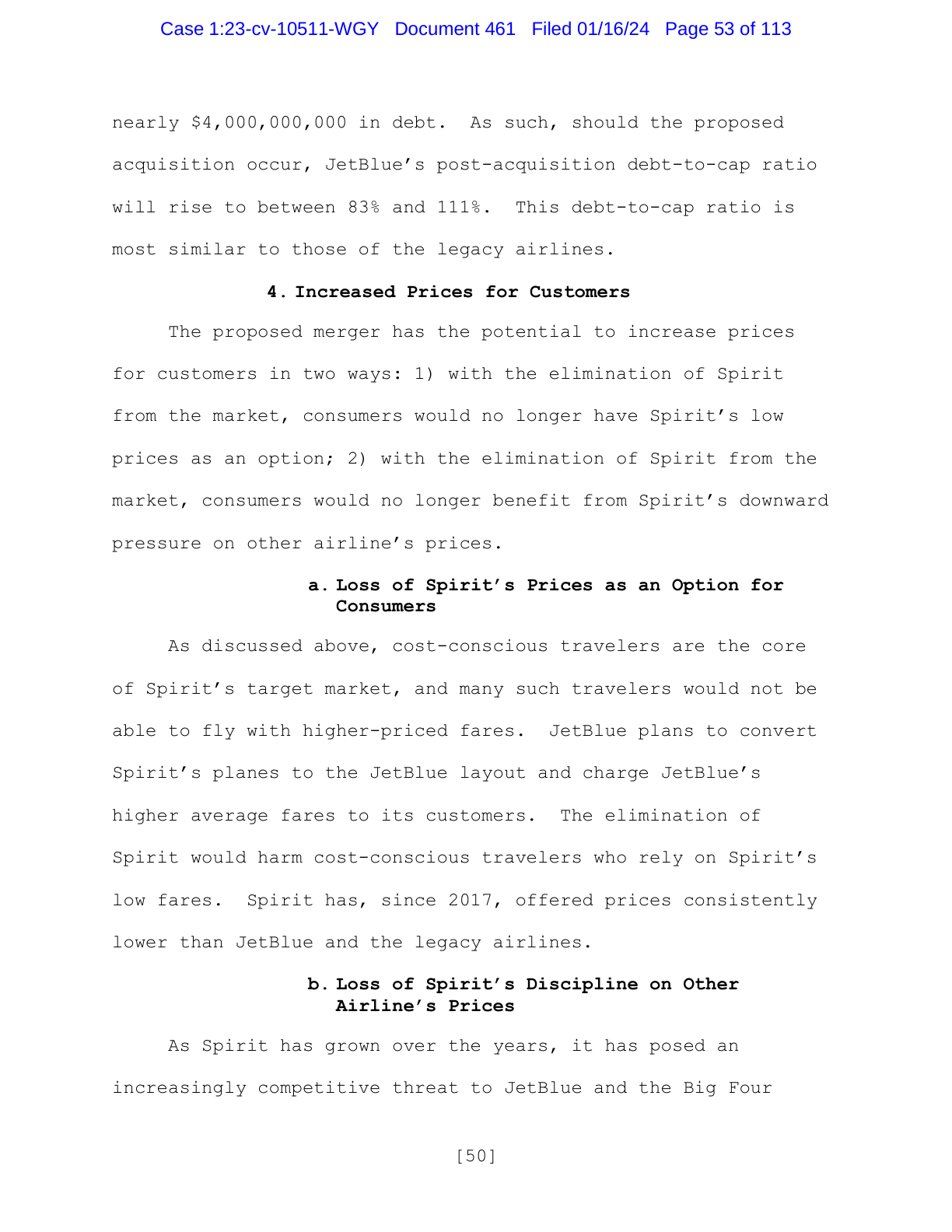
Those were allegations. Ten months later, a federal judge made findings. Judge William Young found that when Spirit enters a market, its rivals cut their prices by 7 to 11 percent on average.C04 He found JetBlue planned to refit Spirit's planes to its own layout and charge its own, higher average fares.C05 On January 16, 2024, he blocked the $3.8 billion deal.C06
"The elimination of Spirit would harm cost-conscious travelers who rely on Spirit's low fares."C31
What the ruling already knew
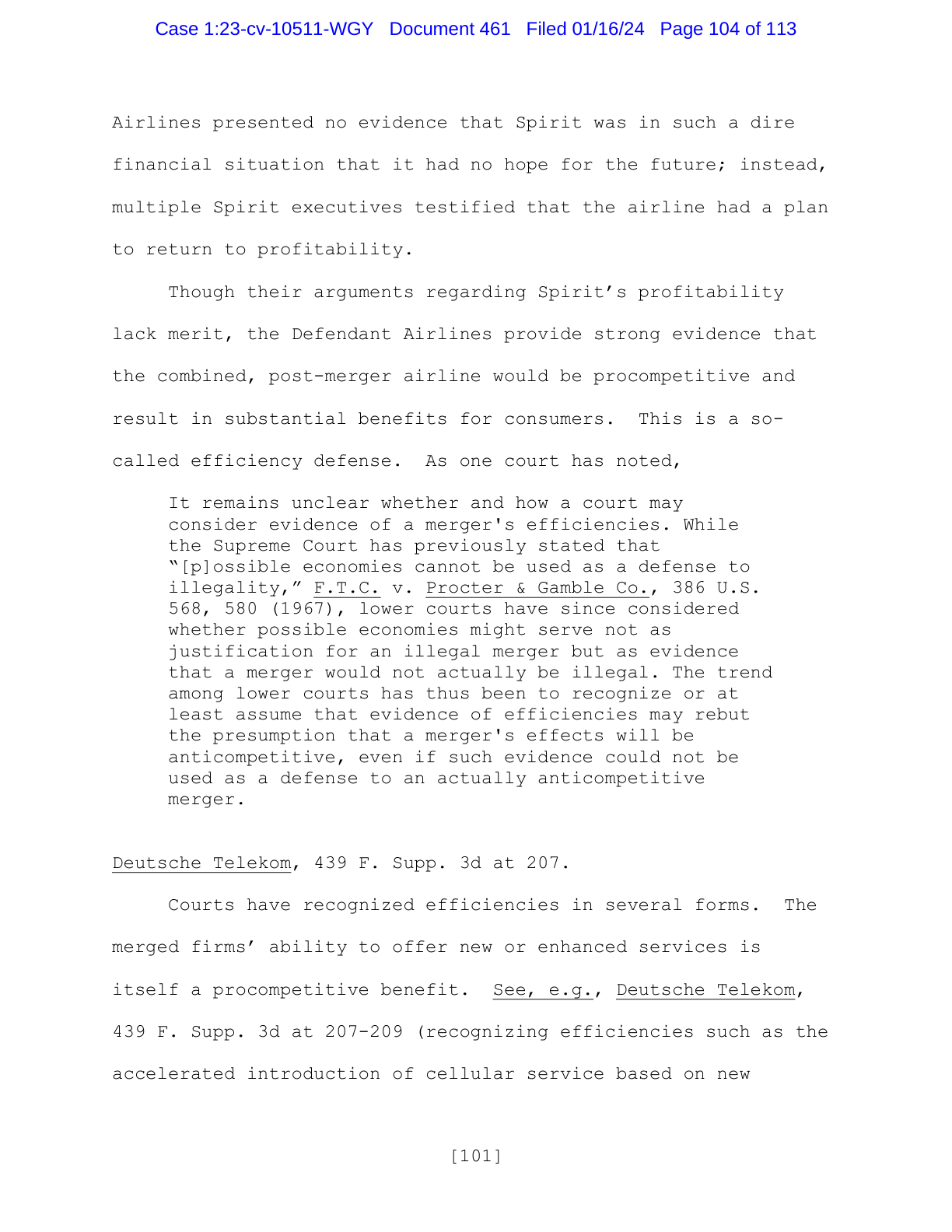
The same ruling, read earlier, holds a second story. The court recorded that Spirit had not been profitable since 2019 and had lost close to $2 billion since the pandemic began.C07 The airlines had argued Spirit's finances mattered to the case. The judge found they had presented no evidence that Spirit was in such a dire financial situation that it had no hope for the future.C08
That was a legal finding about January 2024, not a forecast. Ten months later Spirit was in bankruptcy court.
Filing one: the balance sheet
On November 18, 2024, Spirit filed for Chapter 11 with about $3.6 billion of debt, according to its first-day declaration as reported by CFO Dive.C09 Every large bankruptcy opens with a sworn declaration explaining how the company got there. Spirit's was signed by its chief financial officer. His list, as CFO Dive reported it: failed mergers with Frontier and JetBlue, tougher competition for budget travelers, a changed post-pandemic market, and aircraft manufacturing problems. Low-fare carriers, he wrote, are "disproportionately affected."C10
The fix was narrow. Bondholders swapped about $800 million of debt for shares and put in $350 million of new money.C09 Spirit had lost $1.23 billion in 2024, and in court it projected a profit for 2025.C11 On March 12, 2025, it left bankruptcy.C12
A note on that projection: Spirit's November 2024 draft projections, filed with the SEC, showed 2025 net income of $316 million. A later disclosure statement, as reported by CNBC, put it at $252 million. Both are profits. We could not pull the later document ourselves, so the locker below marks this claim, and the two CFO Dive ones above, as partly supported.
Filing two: the cash
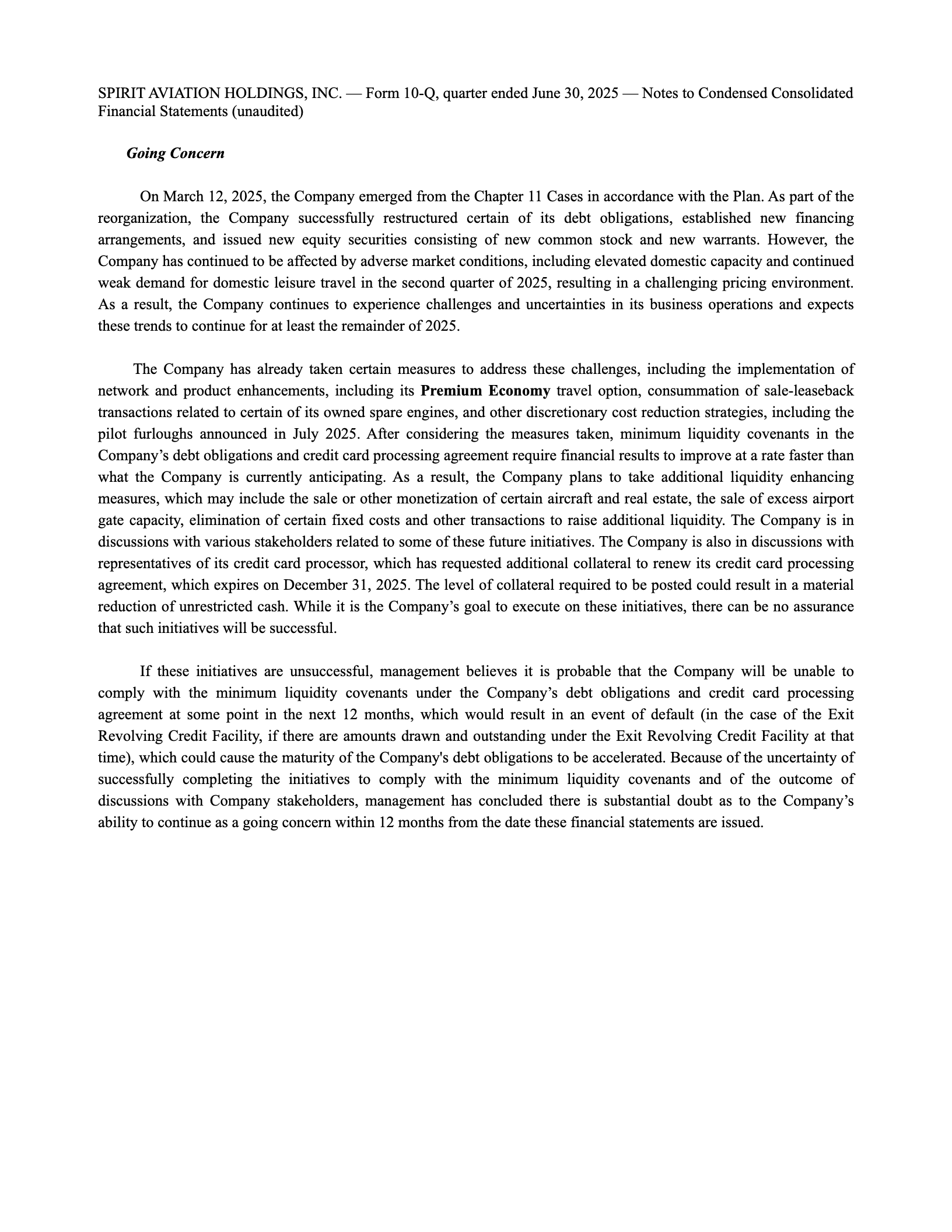
The profit did not come. In the three months to June 2025, Spirit lost $246 million. On August 11, its quarterly report carried the sentence auditors require when they are worried: "substantial doubt" about its ability to continue as a going concern.C13
Then the companies Spirit depended on moved.
- The planes. On August 25, AerCap sent notice terminating leases on 36 aircraft due in 2027 and 2028, each carrying a $2.1 million termination fee.C14
- The card payments. An airline sells tickets long before it flies them. If it fails, its card processor can be left covering the refunds. To keep its processing contract, Spirit agreed to move another $50 million into an account pledged to the processor and to let it hold back up to $3 million a day of Spirit's card sales.C15
- The engines. 38 of Spirit's jets sat grounded waiting for Pratt & Whitney engine repairs, and Spirit expected nearly all 79 of those engines to be grounded within two years.C17
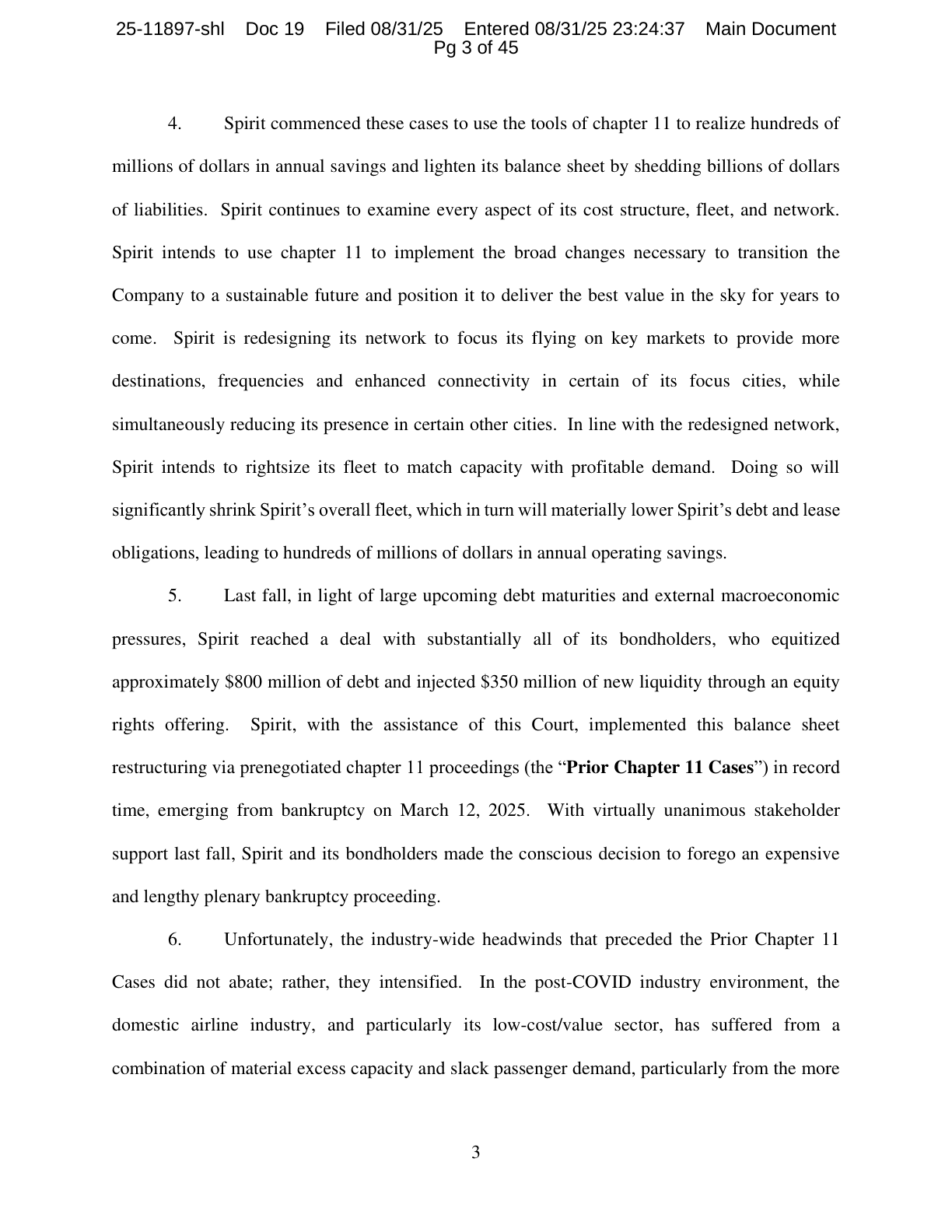
On August 29, 2025, five months after leaving bankruptcy, Spirit filed again.C16 Its second declaration called the first case a "balance sheet restructuring." The problems behind it, it said, "did not abate; rather, they intensified."C29
Filing three: the fuel
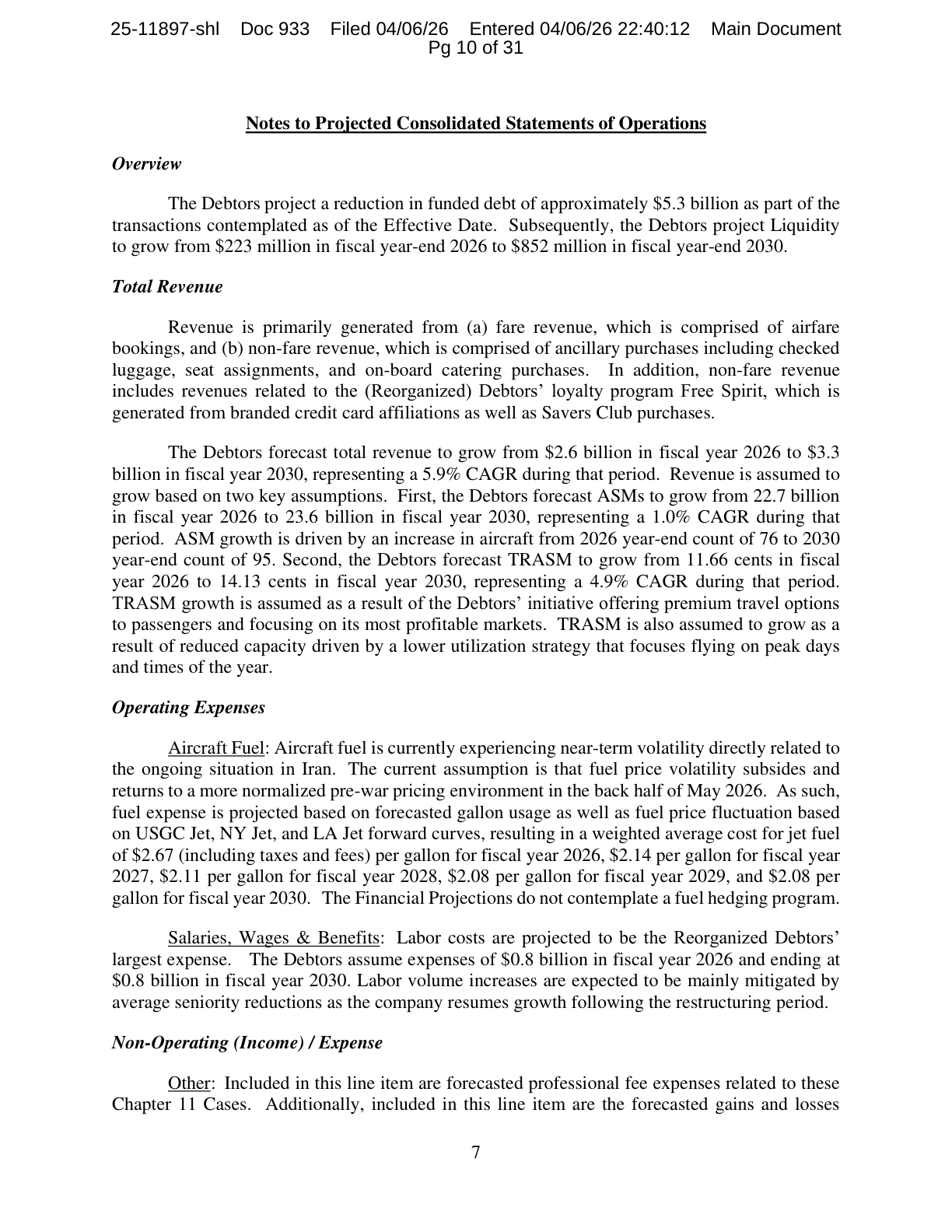
The second bankruptcy was a teardown. Spirit cut its November schedule by 25 percent, cancelled leases on dozens of planes and furloughed crew.C30 By spring 2026 it had a plan: a smaller airline of 76 planes, with about $5.3 billion of debt removed.C18
Then the war with Iran pushed fuel prices up. Spirit's April 6 projections, filed with the court, assumed the spike would pass and fuel would return to pre-war pricing "in the back half of May 2026," for a 2026 average of $2.67 a gallon including taxes and fees. The plan had no fuel hedging. Even with those assumptions, it forecast a 2026 operating loss of $196 million on $2.65 billion of revenue.C19
Jet fuel, US Gulf Coast spot price, weekly average
The government's spot price for jet fuel on the Gulf Coast averaged $3.93 a gallon in April 2026. It is not the same measure as Spirit's assumption, which includes taxes and fees, but it shows the gap. The spot price had crossed $4 for the first time on March 18 and peaked at $4.45 on March 20; in late February it had averaged $2.38.C20 It did not return to pre-war levels in May. In early November 2026 it was still above $4 (see the chart's data file).
There was one last option: advanced talks with the U.S. government over a rescue financing package, about half a billion dollars according to the Transportation Secretary. Spirit was told the money was no longer available.C23 Its third declaration, two days after the last flight, blamed "a massive and sustained increase in fuel prices" and put a number on it: nearly $100 million of extra fuel cost between March 1 and April 30.C22 On May 5, Judge Sean Lane approved the wind-down. "Today is a very challenging day," he said.C24
Three declarations, three explanations: the balance sheet, then the cash, then the fuel. Each was true. None was the whole story. Spirit had gone years without a profit, and even its rescue plan forecast a loss. Any large shock would have been enough.
What happened to fares
In its second filing, Spirit made a promise about prices. Restructured, it said, it would keep disciplining fares on every airline, "saving American consumers hundreds of millions per year - whether they fly Spirit or not."C32 So when Spirit disappeared, did everyone else's fares go up?
Start with the national number. The average U.S. domestic fare in the second quarter of 2026 was $445, the highest second quarter on record before inflation.C25 Flying did get more expensive.
The travel company Engine went route by route through the Department of Transportation's ticket data. Here is what it found on routes where Spirit had carried 40 percent or more of passengers, comparing March-April with May-June 2026:C27
| Measure | Change |
|---|---|
| Average fare paid on the route | +35% |
| Each remaining airline's own fare | −1.4% (range −2.2% to +0.4%) |
| Tickets sold by the remaining airlines | +19% |
| Tickets sold on the route, all airlines | −41% |
How does the average rise 35 percent when the airlines that stayed did not raise their own fares? Because the cheapest tickets on those routes were Spirit's, and they were gone. The average rose because the bottom of the market disappeared. So did many of the travelers.
Nationally, fares on the same routes were about 16 percent higher than a year earlier. Engine found Spirit's exit explains about one point of that. On routes where Spirit was not the cheapest airline, which carried 85 percent of passengers, fares rose about 15 percent anyway.C26
What this data can and can't tell you
- It can show what people paid, route by route, from the government's ticket sample, before and after Spirit stopped flying.
- It can't show what fares would have been if Spirit had survived, or if the JetBlue merger had gone ahead. No document answers that.
- It covers two months after the shutdown. Airlines adjust schedules and prices over longer periods. We will update this page as later quarters of DOT data come out.
- The fare analysis is Engine's, a travel company working from public DOT data. We report its findings and link to them; we did not rerun them.
Who paid
Not, in the first two months at least, the travelers who kept flying: the airlines that stayed held their own fares roughly flat. What disappeared was the cheapest seat, the $39 ticket, for someone who was never going to pay $124.
In 2024, a judge blocked a merger partly because eliminating Spirit would harm the travelers who relied on its low fares. Two years later Spirit was gone anyway, not through a merger, but through debt, then cash, then fuel.
This is general information, not financial advice. Every number on this page links to the document it comes from in the evidence locker below. Found an error? Tell us and we will correct it on this page.
Evidence locker
- C01Spirit stopped flying early on May 2, 2026; its final flight, Detroit to Dallas, landed after midnightVerifiedreportAP: Spirit Airlines has stopped flying (OPB, May 6, 2026) · Open source
- C02Headlines reported fares up as much as 218% on Spirit's busiest routes within 48 hours (one route: Las Vegas-Dallas/Fort Worth, $39 to $124)Verifiedreport24/7 Wall St, May 7, 2026 · Open source
- C03Government complaint: Spirit estimated fares fall 17% when it starts a route; JetBlue estimated fares rise 30% when Spirit stopsVerifiedallegationUS et al. v. JetBlue & Spirit, Amended Complaint, Dkt 69 (D. Mass., Mar 31, 2023); same para 2 as original Dkt 1 (Mar 7, 2023), p. 3 para 2 · Open source
- C04Court found that when Spirit enters a market, its rivals cut prices by 7% to 11% on averageVerifiedfindingUS v. JetBlue, Findings of Fact and Conclusions of Law, Dkt 461 (D. Mass., Jan 16, 2024), p. 55 of 113 · Open source
- C05Court found JetBlue planned to convert Spirit's planes to the JetBlue layout and charge JetBlue's higher average faresVerifiedfindingUS v. JetBlue, Findings of Fact and Conclusions of Law, Dkt 461, p. 53 of 113 · Open source
- C06Judge William Young permanently enjoined the $3.8B merger on Jan 16, 2024, writing: 'Spirit is a small airline. But there are those who love it. To those dedicated customers of Spirit, this one's for you.'VerifiedfindingUS v. JetBlue, Findings of Fact and Conclusions of Law, Dkt 461, p. 112 of 113 (PDF; quote) · Open source
- C07The same ruling recorded that Spirit had not been profitable since 2019, with a cumulative net loss close to $2 billion since the pandemic beganVerifiedfindingUS v. JetBlue, Findings of Fact and Conclusions of Law, Dkt 461, p. 27 of 113 · Open source
- C08Court found the airlines presented no evidence Spirit was in such a dire financial situation that it had no hope for the futureVerifiedfindingUS v. JetBlue, Findings of Fact and Conclusions of Law, Dkt 461, p. 104 of 113 (PDF) · Open source
- C09Spirit filed Chapter 11 on Nov 18, 2024 with about $3.6B of debt; bondholders equitized approximately $800M of debt and injected $350MPartly supportedself-reportedDebt total: Cromer First Day Declaration, No. 24-11988, Dkt 2 (via CFO Dive). Equitization: Cromer First Day Declaration, In re Spirit Aviation Holdings, No. 25-11897, Doc 19 (Aug 31, 2025), Doc 19 p. 3 para 5 · Open source
- C10The CFO's declaration blamed failed mergers with Frontier and JetBlue, competition for budget travelers, a changed post-pandemic market and aircraft manufacturing issues, adding that 'low-fare carriers... are disproportionately affected'Partly supportedself-reportedCromer First Day Declaration, No. 24-11988, Dkt 2 (via CFO Dive) · Open source
- C11Spirit lost $1,229.5M in 2024 (10-K). Its November 2024 draft projections filed with the SEC showed 2025 net income of $316M; a later disclosure statement put it at $252M, as reported by CNBC. Both are profits.Partly supportedself-reportedLoss: Spirit 10-K FY2024 (Results of Operations). Projection: Dec 2024 disclosure statement (via CNBC/Financier Worldwide); draft projections: 8-K Ex. 99.2 Nov 2024, 10-K MD&A · Open source
- C12Spirit emerged from its first bankruptcy on March 12, 2025Verifiedself-reportedCromer First Day Declaration, In re Spirit Aviation Holdings, No. 25-11897, Doc 19 (Aug 31, 2025), Doc 19 p. 3 para 5 · Open source
- C13Spirit lost $246M in Q2 2025; on Aug 11, 2025 its quarterly report said there was 'substantial doubt' about its ability to continue as a going concern within 12 monthsVerifiedself-reportedSpirit Aviation Holdings Form 10-Q, Q2 2025 (net loss $245,831K, three months ended June 30, 2025; going-concern statement), Income statement; Going Concern note · Open source
- C14On Aug 25, 2025 AerCap sent notice terminating 36 leases for aircraft due in 2027-28, triggering a $2.1M termination fee per leaseVerifiedself-reported8-K Aug 29, 2025 Item 2.04; Cromer First Day Declaration, In re Spirit Aviation Holdings, No. 25-11897, Doc 19 (Aug 31, 2025), 8-K Item 2.04; Doc 19 pp. 6, 12 · Open source
- C15Spirit agreed with its card processor Elavon (U.S. Bank) to transfer an additional $50M to a pledged account (Aug 15, 2025) and to let Elavon hold back up to $3M a day until fully collateralized (Aug 20, 2025), in exchange for extending the processing contract beyond Dec 31, 2025. Holdbacks cover customer refunds if Spirit fails to flyVerifiedself-reportedCromer First Day Declaration, In re Spirit Aviation Holdings, No. 25-11897, Doc 19 (Aug 31, 2025), Doc 19 pp. 20-21 paras 48-49 · Open source
- C16Spirit filed for Chapter 11 a second time on Aug 29, 2025, five months after emergingVerifiedself-reportedSpirit Aviation Holdings Form 8-K, Aug 29, 2025, Item 1.03, Item 1.03 · Open source
- C17As of Aug 29, 2025, 38 GTF-powered aircraft were grounded awaiting engine repairs; Spirit expected nearly all 79 of its GTF engines to be grounded within two yearsVerifiedself-reportedCromer First Day Declaration, In re Spirit Aviation Holdings, No. 25-11897, Doc 19 (Aug 31, 2025), Doc 19 p. 5 · Open source
- C18Spirit's reorganization plan projected cutting funded debt by about $5.3B and ending 2026 with 76 aircraftVerifiedself-reportedExhibits to Disclosure Statement (Financial Projections), No. 25-11897, Doc 933 (Apr 6, 2026), Doc 933 p. 10 (Notes, Overview; Total Revenue) · Open source
- C19Spirit's April 2026 projections assumed fuel volatility from the Iran situation would subside and return to pre-war pricing 'in the back half of May 2026', for a weighted average of $2.67/gal in 2026 (incl. taxes and fees) and $2.14 in 2027; 'The Financial Projections do not contemplate a fuel hedging program'; 2026F operating loss of $196M on revenue of $2,648MVerifiedself-reportedExhibits to Disclosure Statement (Financial Projections), No. 25-11897, Doc 933 (Apr 6, 2026), Doc 933 pp. 9-10 · Open source
- C20US Gulf Coast jet fuel spot averaged $3.93 a gallon in April 2026 (EIA daily series; 21 trading days), against Spirit's 2026 assumption of $2.67 including taxes and fees (C19). First close above $4 on Mar 18, 2026; peak $4.454 on Mar 20; pre-war late-Feb average $2.38. Mid-April (Apr 13-17) was $3.49-$3.86.VerifiedstatisticEIA, U.S. Gulf Coast Kerosene-Type Jet Fuel Spot Price FOB, daily (series EER_EPJK_PF4_RGC_DPG); press: Reuters Apr 16, 2026 ($4.24, benchmark not verifiable), daily table, Mar-Apr 2026 (saved in evidence/sources) · Open source
- C22Spirit's third declaration: 'Recent geopolitical events have resulted in a massive and sustained increase in fuel prices, and a corresponding rapid and unexpected decline in the Debtors' liquidity situation'; between March 1 and April 30, 2026 its incremental fuel cost was nearly $100M. (Spirit's lawyer separately told the May 5 hearing fuel 'engulfed Spirit entirely' - AP)Verifiedself-reportedCromer Declaration ISO Wind-Down Motions, No. 25-11897, Doc 1011 (May 4, 2026), Doc 1011 pp. 3-4 paras 4, 6 · Open source
- C23Spirit was in advanced discussions with the U.S. government on a rescue financing package; it was told the financing was no longer available and 'concluded that it had no choice but to pursue the Wind-Down'. Size (about half a billion dollars) per Transportation Secretary Duffy, reported by APVerifiedself-reportedCromer Declaration ISO Wind-Down Motions, No. 25-11897, Doc 1011 (May 4, 2026); AP (OPB, May 6, 2026), Doc 1011 p. 4 para 7 · Open source
- C24Judge Sean Lane approved the wind-down on May 5, 2026: 'Today is a very challenging day. It's not a day that anybody hoped would ever come.'VerifiedfindingAP report of May 5, 2026 hearing (OPB) · Open source
- C25The average US domestic fare in Q2 2026 was $445, the highest second-quarter fare on record before inflationVerifiedstatisticBTS press release, Second Quarter 2026 Average Air Fare · Open source
- C26Domestic fares rose about 16% year on year on the same routes (Apr-Jun 2026 vs 2025); Spirit's exit explains about 1 point of that; on routes where Spirit was not the cheapest airline (85% of passengers), fares rose about 15% anywayVerifiedstatisticEngine analysis of DOT ticket data (DB1C, Domestic Airfare Consumer Report), Oct 2026 · Open source
- C27On routes where Spirit carried 40%+ of passengers, the average fare paid rose 35% (Mar-Apr vs May-Jun 2026), but each remaining airline's own fare fell 1.4%; tickets sold fell 41% even though remaining airlines sold 19% more; range for remaining airlines -2.2% to +0.4%VerifiedstatisticEngine analysis of DOT ticket data, Oct 2026 · Open source
- C29Second declaration: the first case was a 'balance sheet restructuring' done in record time; 'the industry-wide headwinds that preceded the Prior Chapter 11 Cases did not abate; rather, they intensified'Verifiedself-reportedCromer First Day Declaration, In re Spirit Aviation Holdings, No. 25-11897, Doc 19 (Aug 31, 2025), Doc 19 p. 3 paras 5-6 · Open source
- C30During the second case Spirit cut its November schedule by 25%, cancelled leases on dozens of planes and furloughed crewVerifiedreportTravelPulse citing Reuters and Spirit filing, Oct 15, 2025 · Open source
- C31Court: 'The elimination of Spirit would harm cost-conscious travelers who rely on Spirit's low fares.'VerifiedfindingUS v. JetBlue, Findings of Fact and Conclusions of Law, Dkt 461, p. 53 of 113 · Open source
- C32Spirit told the court that once restructured it would again be disciplining domestic prices on all carriers, 'thereby saving American consumers hundreds of millions per year - whether they fly Spirit or not'Verifiedself-reportedCromer First Day Declaration, In re Spirit Aviation Holdings, No. 25-11897, Doc 19 (Aug 31, 2025), Doc 19 p. 6 para 10 · Open source
Download the data
- Jet fuel spot price, weekly averages, 2025-2026 (CSV)
- Claims sheet (every claim, its document and status)
Corrections
Full transcript of the film
Just after midnight on May 2nd, 2026, a yellow plane from Detroit landed in Dallas. It was the last flight Spirit Airlines would ever fly. A few hours later, the company stopped flying for good. Within days, the headlines had a number. Fares up as much as 218 percent. But Spirit didn't die on May 2nd.
For eighteen months, it had been explaining how it was dying, in sworn court filings. And the government's own ticket data says the thing almost everyone believes about what happened next is only half true. This is the paper trail. To see why anyone cared, start with a lawsuit.
In March 2023, the Justice Department sued to stop JetBlue from buying Spirit. Its complaint put two airline estimates side by side. Spirit's: when Spirit starts flying a route, average fares fall 17 percent. JetBlue's: when Spirit stops flying one, average fares go up 30 percent. Those were allegations. Ten months later, a federal judge turned the core of them into findings.
Judge William Young found that when Spirit enters a market, its rivals cut their prices by 7 to 11 percent on average. He found JetBlue planned to convert Spirit's planes to its own layout and charge its own, higher fares. On January 16th, 2024, he blocked the 3.8 billion dollar deal, and ended his ruling with a line people still quote.
"Spirit is a small airline. But there are those who love it. To those dedicated customers of Spirit, this one's for you." He also wrote that eliminating Spirit "would harm cost-conscious travelers who rely on Spirit's low fares." Hold on to that sentence. We'll come back to it.
Read the same ruling eighty pages earlier, and there's a second story. The court recorded that Spirit had not made a profit since 2019, and had lost close to two billion dollars since the pandemic began. The judge weighed whether those losses changed the answer. He found they didn't. The airlines, he wrote, had presented no evidence that Spirit was in such a dire financial situation that it had no hope for the future.
That was a legal finding about January 2024. It was not a promise about the future. Ten months later, Spirit was in bankruptcy court. On November 18th, 2024, Spirit filed for Chapter 11. Every big bankruptcy opens with a sworn declaration explaining how the company got there. Spirit's was signed by its chief financial officer.
His list: two failed mergers, first with Frontier, then with JetBlue. Tougher competition for budget travelers. A post-pandemic market that had changed. Aircraft manufacturing problems and maintenance recalls. And one line that sums up the whole business model. Low-fare carriers, he wrote, "whose business models rely on much slimmer margins," are "disproportionately affected."
The fix was narrow. Spirit owed about 3.6 billion dollars. Its bondholders would swap about 800 million dollars of it for shares, put in 350 million of new cash, and Spirit would keep flying as normal. Spirit had lost 1.2 billion dollars in 2024. In court, it projected that in 2025 it would turn a profit of hundreds of millions of dollars. On March 12th, 2025, Spirit walked out of bankruptcy.
The profit never came. In the three months to June, Spirit lost 246 million dollars. On August 11th, its quarterly report carried the sentence auditors require when they are worried: "substantial doubt" about the company's ability to continue as a going concern. Then the people Spirit depended on started moving. On August 25th, AerCap, one of the world's biggest aircraft lessors, sent notice terminating the leases on 36 new planes Spirit was due to receive in 2027 and 2028. Spirit disputed it.
Each termination came with a 2.1 million dollar fee. At the same time, the bank that processed Spirit's card payments wanted more protection. An airline sells tickets long before it flies them, and if it collapses, the card processor can be left covering the refunds. To keep that contract alive, Spirit agreed to put another 50 million dollars into an account pledged to the processor, and to let it hold back up to 3 million dollars a day of Spirit's ticket sales.
Meanwhile, 38 of Spirit's jets sat grounded, waiting on Pratt & Whitney engine repairs. On August 29th, 2025, five months after leaving its first bankruptcy, Spirit filed again. Its second sworn declaration called the first case a balance sheet restructuring, done in record time. The problems behind it, it said, "did not abate; rather, they intensified." The second bankruptcy was a teardown.
Spirit cut its schedule, cancelled leases on dozens of planes and furloughed crews. By spring 2026, it had a plan: a smaller airline of 76 planes, with about 5.3 billion dollars of debt wiped away. Then war with Iran sent fuel prices soaring. Spirit's April projections, filed with the court, assumed the spike would pass. Fuel, they said, would return to normal "in the back half of May," for an average of about two dollars and sixty-seven cents a gallon for the year.
The plan included no fuel hedging at all. And even with those assumptions, it forecast an operating loss of 196 million dollars for 2026. There was no cushion. There was one last door: advanced talks with the U.S. government over a rescue package worth about half a billion dollars. Spirit was told the money was no longer available.
In the early hours of May 2nd, it stopped flying. Two days later came the third sworn declaration. It blamed a "massive and sustained increase in fuel prices," and put a number on it: between March 1st and April 30th alone, nearly 100 million dollars of extra fuel cost. With the rescue gone, it said, Spirit "concluded that it had no choice." The next day, Judge Sean Lane approved the wind-down.
"Today is a very challenging day," he said. "It's not a day that anybody hoped would ever come." So that's three sworn declarations and three explanations. The balance sheet. Then the cash. Then the fuel. Each was true. None was the whole story, because the whole story was the margin. Spirit had gone years without a profit, and even its rescue plan forecast a loss for 2026. Any shock would have been enough.
Now, back to that number from the start. 218 percent. In its second bankruptcy filing, Spirit had made a promise about exactly this. Restructured, it said, it would keep disciplining prices on every airline, "saving American consumers hundreds of millions per year, whether they fly Spirit or not." So when Spirit disappeared, what happened to those prices?
That 218 percent came from single routes in the first 48 hours, like Las Vegas to Dallas going from 39 dollars to 124. There's better evidence now: the Department of Transportation's own ticket data. The Bureau of Transportation Statistics says the average domestic fare in the second quarter of 2026 was 445 dollars, the highest second quarter it has ever recorded before inflation.
So flying did get more expensive. But how much of that was Spirit? The travel company Engine ran the government's ticket data route by route. On routes where Spirit had carried 40 percent or more of the passengers, the average fare people paid in May and June was 35 percent higher than in March and April. That's the headline, and it's real.
But then they compared each airline that kept flying those routes with itself. Its own fares didn't go up. They went down, by 1.4 percent. So how does the average jump 35 percent when the airlines that stayed didn't raise theirs? Because the cheapest tickets on those routes were Spirit's, and Spirit's tickets were gone.
The average went up because the bottom of the market disappeared. And so did a lot of the travelers. On those routes, tickets sold fell 41 percent, even though the airlines that stayed sold 19 percent more. Across the whole country, fares on the same routes were about 16 percent higher than a year earlier. Engine found Spirit's exit explains about one point of that.
On the routes where Spirit wasn't the cheapest airline, which carried 85 percent of passengers, fares went up about 15 percent anyway. So what did Spirit's death actually cost? Not higher prices from every other airline. In the first two months, at least, the data doesn't show that. It cost the cheapest seat.
The 39 dollar ticket, for someone who was never going to pay 124. In 2024, a judge blocked a merger because eliminating Spirit would harm the travelers who relied on its low fares, and because, by his findings, JetBlue would have charged its own higher ones. Two years later, Spirit was eliminated anyway. Not by a merger, but by debt, then cash, then fuel.
Whether the merger would have saved Spirit is a question no document can answer. What the ticket data can answer is who paid. Not the people who kept flying. The people who stopped flying those routes. Every number in this video, and the document it comes from, is in the description. This is Line Item.